| Wednesday - 10 June 2026 | Ard Easmuinn, Dundalk, Co. Louth, Ireland |
| Holy Days |
|
The Feast of the Immaculate Conception celebrates belief in the Immaculate Conception of the Blessed Virgin Mary. It is celebrated on 8 December, nine months before the Nativity of Mary, which is celebrated on 8 September. The doctrine states that, from the first moment of her existence, Mary was preserved by God from the Original Sin and filled with sanctifying grace that would normally come with baptism after birth. Catholics believe Mary "was free from any personal or hereditary sin". Mary's immaculate conception should not be confused with the Incarnation of her son Jesus Christ; the conception of Jesus is celebrated as the Annunciation to Mary. Catholics do not believe that Mary, herself, was the product of a Virgin Birth.
From early on in the history of the Catholic Church, numerous places in the writings of the Catholic Church Fathers the belief is implicitly stated. In various places the feast of the Immaculate Conception, had been celebrated for centuries on 8 December , when, on 28 February 1476, Pope Sixtus IV extended it to the entire Latin Church. He did not define the doctrine as a dogma, thus leaving Roman Catholics free to believe in it or not without being accused of heresy; this freedom was reiterated by the Council of Trent. However, the feast was a strong indication of the Church's traditional belief in the Immaculate Conception. On 6 December 1708 Pope Clement XI decreed that the feast of the Immaculate Conception be a Holy Day of Obligation throughout the entire Catholic Church. The Immaculate Conception was solemnly defined as a dogma by Pope Pius IX in his constitution Ineffabilis Deus on 8 December 1854. The Catholic Church teaches that the dogma is supported by Scripture (e.g., Mary's being greeted by the Angel Gabriel as "full of grace") as well as either directly or indirectly by the writings of Church Fathers such as Irenaeus of Lyons and Ambrose of Milan. Catholic theology maintains that since Jesus became incarnate of the Virgin Mary, it was fitting that she be completely free of sin for expressing her fiat. In 1904 Pope Saint Pius X also addressed the issue in his Marian encyclical Ad Diem Illum on the Immaculate Conception.[
Please note the 7.30pm Mass will be a Healing Mass in conjunction with the Family of God Community. The Blessing of the sick will take place at the end of the Mass.
Holy Days of Obligation |
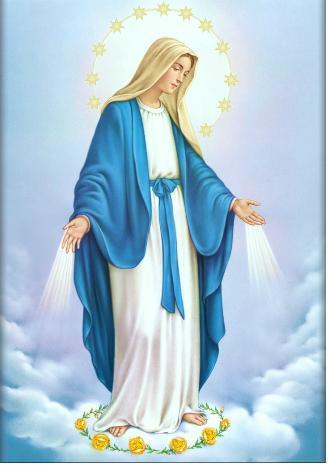 Wednesday 8th December: The Feast of The Immaculate Conception